

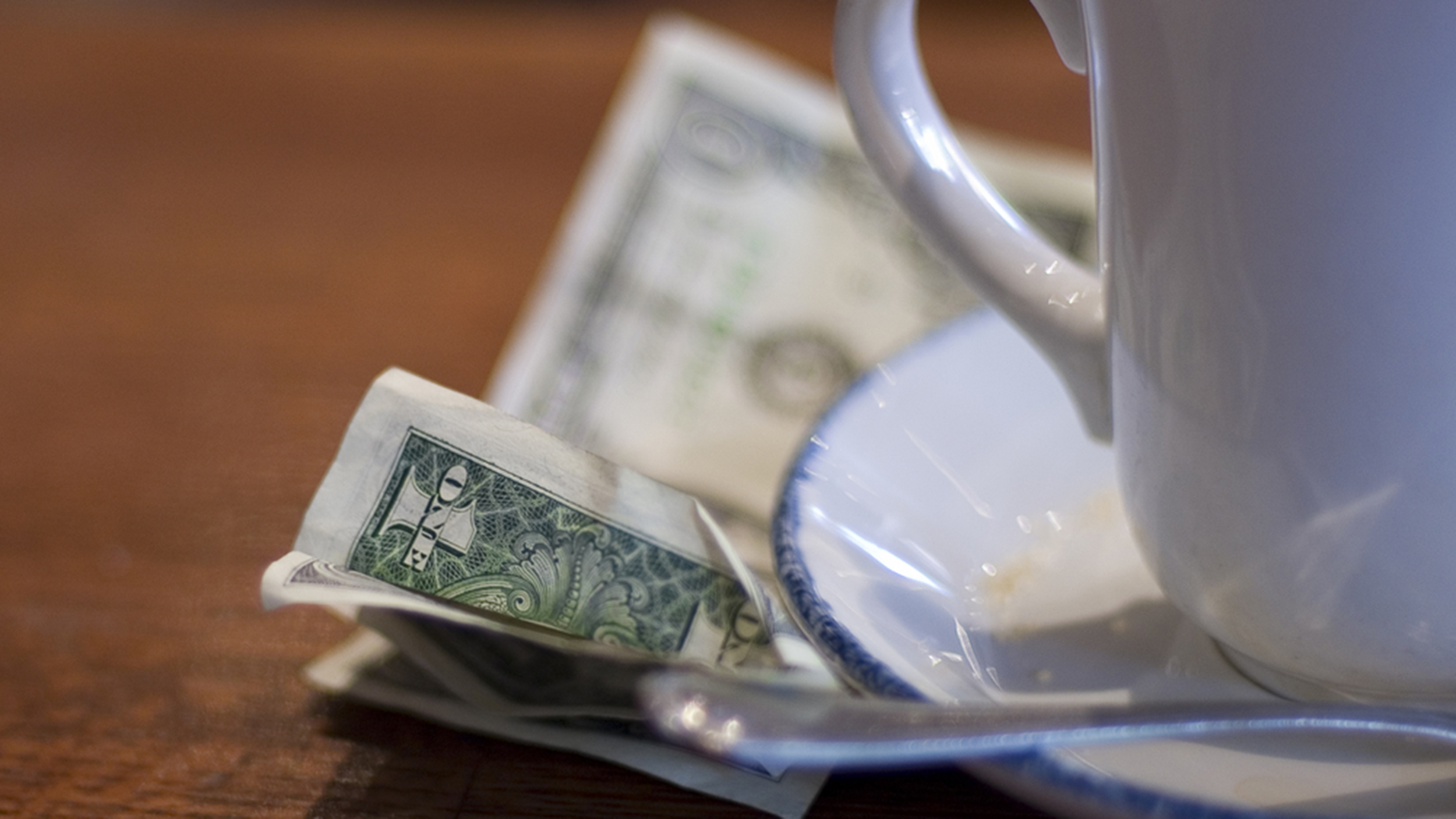
Tipping in the United States: Not a Pretty Story
I learned the unhappy history of tipping in the U.S. only within the past month. Then I was inspired to write this blog upon reading an op-ed piece by Danny Meyer, the highly successful New York restaurateur who was my model for Gino Milano, the hero of Love After All.
Tipping customs vary from country to country. In China, Japan, Korea and Hong Kong there is no tipping. In Japan it would even be considered rude. In Iceland it would be all right to round up your bill to the next even number. In Brazil a restaurant bill may come with a service charge that is not mandatory to pay. In New Zealand there is no tipping, but one would be appreciated. In many places around the world it is customary to add 10%.
Before you travel find out who to tip and how much to tip.
Now we come to the United States where it is customary for Americans to tip up to 20% in bars and restaurants.
Tipping History
Saru Jayaraman, a labor activist, tells the story of American tipping in Forked: A New Standard for American Dining (2016). Maddie Oatman, in her Mother Jones review of Forked writes:
“European aristocrats popularized the habit of slipping gratuities to their hosts’ servants, and by the mid-1800s rich Americans, hoping to flaunt their European sophistication, had brought the practice home. Restaurants and rail operators, notably Pullman, embraced tipping primarily, Jayaraman says, because it enabled them to save money by hiring newly freed slaves to work for tips alone. Plenty of Americans frowned upon the practice, and a union-led movement begat bans on tipping in several states. The fervor spread to Europe, too, before fizzling in the United States—by 1926, the state tipping bans had been repealed.”
In 1938 Congress passed America’s first minimum-wage law and allowed states to set a lower wage for tipped workers … and now we fast-forward to the present.
Tipping Today
Under current regulations tips can be given only to “guest facing” service staff. This is where Danny Meyer enters the picture because a new Labor Department policy proposes to make tips the property of the employer who could then (but would be under no legal obligation to) distribute the money among all the workers, including cooks and dishwashers. The new policy is aimed at leveling the disparity between workers at the back of the house who take in considerably less than those who work at the front of the house.
About this troubling wage disparity Meyer writes, “Dictating tip distribution is not the way to solve the problem. Tips themselves are the problem, and we need to stop relying on them as a means to compensate this massive workforce.”
Two years ago he began eliminating tips in his New York restaurants and repriced his menus to reflect the full cost of compensating the entire staff. He did it to decrease the pay gap between servers and cooks and to provide transparency into the true cost of operating a restaurant. “More significantly,” he adds, “we did it to provide our employees with the professionalism that is standard in most other industries.”
Meyer’s statement made me think of Japan where it is considered rude to tip because those performing a service are doing their job as professionals and are compensated as such by their employers.
Meyer’s statement also made me think of the excellent service I have had at restaurants around the world where it was clear the staff had chosen hospitality as their profession and not as a stop-gap.
Because I so admired the philosophy of hospitality – and the business ethic in general – Meyers laid out in Setting the Table, I take seriously his position on tipping.

I can’t now remember whether I read Setting the Table, fell in love with Meyer’s philosophy and then decided to model my hero, Gino, after him in Love After All or whether I had already decided to make Gino a restaurateur which prompted me to read Setting the Table. Either way it made an impression on me.
Meyers knows that tipping practices in the United States won’t change over night. But I’m glad the conversation had started.
Title image: Shutterstock ID 6513259
For more about Danny Meyer see also: Centering Your Salt Shaker
Categorised in: Adventure, North America, Thoughts
This post was written by Julie Tetel Andresen
You may also like these stories:


- google+
- comment